Wind, limbs and heavy rain on local roofs
Storm-Damaged Roofs in Maplewood, NJ
After a gust, a fallen limb or a night of hard rain, storm-damaged roofs in Maplewood, NJ often show lifted shingles, bent metal or a fresh stain. Call (862) 358-4524 once the look from the ground is done and describe what you saw.
Have these ready
Notes to jot down before the call
- The street address and which side of the house took the weather.
- What landed: a limb, loose siding, a neighbor's fence panel.
- Where water shows inside, and when you noticed it.
- Photos in the order you took them, ground first and attic last.
- Whether the insurer has been told, since the roofer may be asked.
How soon is soon
Storm damage by how worried to be
A wire down, a tree against the house with noises, water at a fixture
Get out of the way and call 911 or the electric utility
Shingles gone and rain getting in
Move belongings, catch drips, then call (862) 358-4524 this week to describe the damage
A few shingle bits on the lawn and nothing inside
Photograph the roof from the yard and check the attic after the next rain
Get away and call for help if
- A downed wire, or a limb caught in wires: keep 30 feet away, assume the wire is live, and give PSE&G (1-800-436-7734) or 911 the location. Do not try to cut the limb.
- A tree resting on the house, with cracking sounds or a sagging roof line: leave the house and call 911.
- Water pouring through a ceiling light or a wall outlet: leave the room, stay clear and call 911 from a dry spot.
- Littered, wet or icy shingles: do not climb up to clear them. Stay on the ground and let a roofer do the climbing.
Five questions
Questions this job brings up
What is the safest first look after a storm?
The roofing manufacturers' trade group, writing after Superstorm Sandy, advised a first look from the yard or an upstairs window, using binoculars where possible. It adds that the attic side of the roof, especially the flashings, is where leaks tend to show first.
Who gets the first call, the insurer or the roofer?
The state insurance department says to phone the agent or insurer soon after the damage, make the temporary repairs the situation calls for, and keep every receipt. The insurer assigns the adjuster. Using the contractor the insurer suggests is optional. The department also staffs a consumer hotline, 1-800-446-7467.
What have recent storms done to roofs around here?
On 4 August 2020 Isaias cut electricity to 1 million-plus New Jersey customers, and some waited five days to get it back, as fallen trees crushed buildings and brought down lines. Sandy gusted to 78 mph in Newark, and Ida put 8.39 inches of rain on Maplewood in two days.
Who knocks on doors after a storm?
The roofing trade group warns that storms bring in contractors who take advantage, and advises caution with anyone asking for money up front. Federal rules give three days to cancel many at-home sales, with exceptions for emergencies and for visits you requested.
Is storm work available in South Orange, West Orange and the rest?
Yes. The contractor covers Maplewood and the five towns around it. South Orange roofing, West Orange roofing, Millburn roofing, Irvington roofing and Union roofing all have pages of their own. Describe the damage when you call (862) 358-4524.
Looks from the ground
Stick to looks taken from the yard, a window or the attic hatch. Anything that needs a ladder or a walk across the roof belongs to a roofer.
- Look at the wires before the roof. Anything touching or near them is the utility's business, not a homeowner's.
- Use binoculars along the ridge, the edges and the chimney from the yard, then photograph every slope. The roofing manufacturers' trade group recommends starting at ground level.
- Pick up any shingle pieces lying on the grass and put them in a pile; the roofer can tell from them which shingle is up there.
- Through the attic hatch, sweep a flashlight along the roof boards and around vent pipes, where leaks tend to begin.
Questions for the roofer
Questions after a windy night
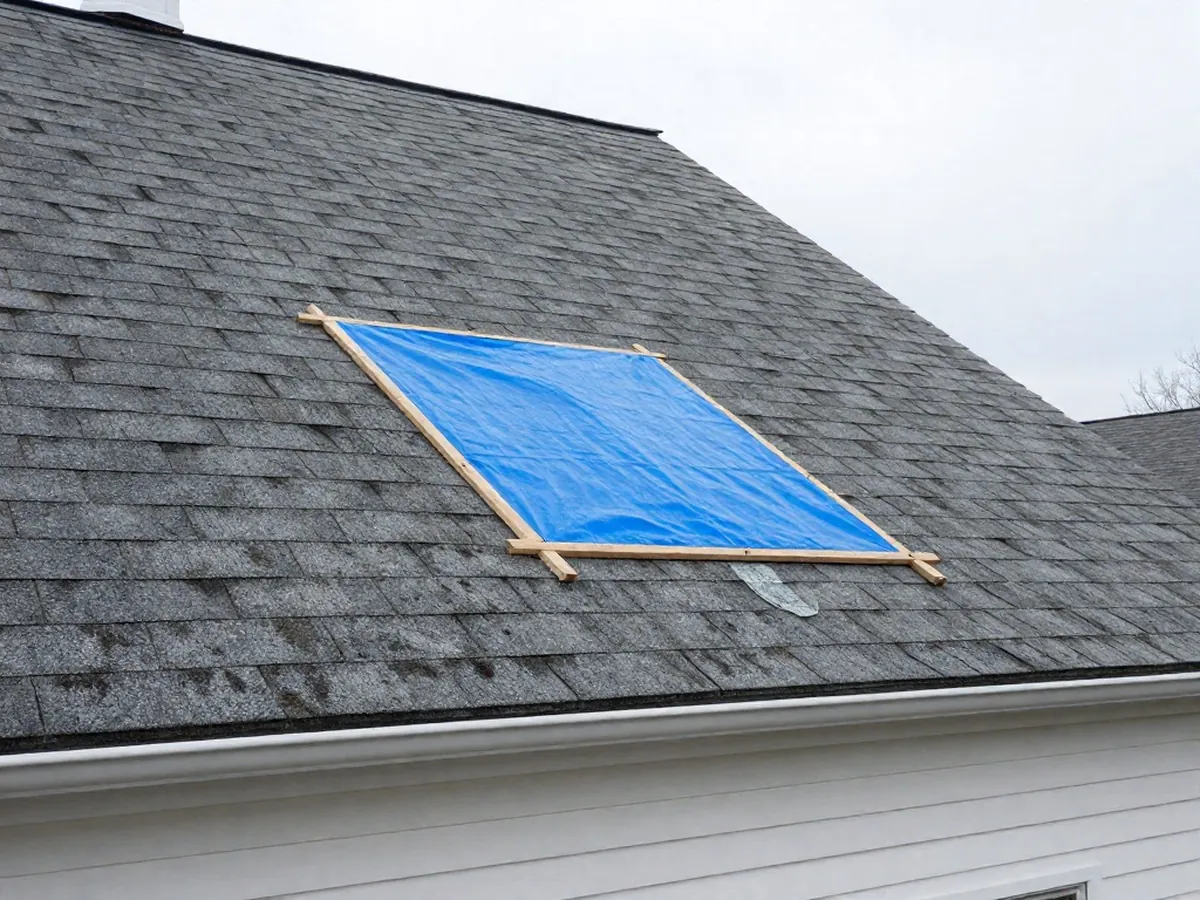
Ask whether the damage looks like wind, a falling limb or old wear, and what points the roofer to that answer. Ask what temporary covering is possible and what it can and cannot hold back.
Ask for photos of the damaged spots before repairs begin, and for a written scope that names the materials.
What you might notice
What you might notice
- Shingles missing or creased along the ridge and the edges after wind
- A limb, a branch or an entire tree lying across the roof or the gutter
- Flashing or a vent cap bent, loose or gone from the roof
- A fresh ceiling stain or drip a day after heavy rain
- Gutters knocked loose, bent or stuffed with pieces of shingle
Moves that backfire
After a storm, three moves that backfire later
- Hauling damaged pieces to the curb before taking pictures.
The state insurance department asks for photos first and a receipt for every temporary repair.
- Cutting a limb that rests on a wire.
PSE&G says not to cut or remove any tree that is, or might become, tangled in power lines.
- Handing a door-knocker the full amount.
The trade group's warning on money up front applies after any storm, not only Sandy.
Where the paperwork lives
Storm repairs and the paperwork
Ordinary maintenance in the state code includes roof-covering repairs and replacement on a stand-alone house of one or two units. Work that touches the structure or fire safety does not, so a tree that went through the framing is a different conversation.
The rules page says where to ask in each town.